192GB of HBM3e at 8 TB/s — more than double H100's memory and bandwidth. Native FP4 precision delivers 18 PFLOPS of sparse AI compute. A genuine architecture jump, not a memory refresh.
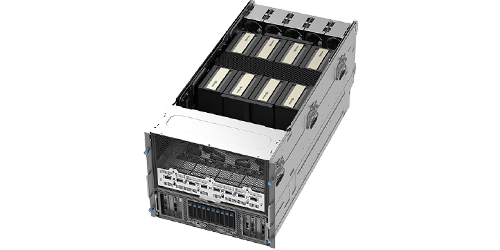
H100 and H200 share the same Hopper die. B200 is Blackwell — a different chip with a different precision format, different interconnect and different cooling requirements.
Two reticle-limit dies linked by a 10 TB/s NVLink-HBI bridge. The OS sees one unified GPU, but the silicon is two 4NP dies working as one.
Second-generation Transformer Engine introduces FP4 and FP6 — 18 PFLOPS of sparse FP4 compute per GPU. Roughly 4× the H100's training throughput.
Fifth-generation NVLink doubles inter-GPU bandwidth to 1.8 TB/s. NVSwitch 5.0 provides all-to-all connectivity for tensor parallelism and disaggregated serving.
The B200 is a different league. On MLPerf Training v4.1, HGX B200 delivered up to 2.2× per-GPU performance vs HGX H200. Against H100, the gap is even wider.
Blackwell is the first NVIDIA data-centre GPU built from two reticle-limit dies. A 10 TB/s NVLink-HBI bridge stitches them into a single logical GPU with unified memory.
The reticle limit caps a single die at roughly 858 mm². To build a GPU with 208 billion transistors, NVIDIA split Blackwell into two dies and connected them with a 10 TB/s die-to-die bridge. Each die has its own 4,096-bit memory bus with four HBM3e stacks — 96GB per die, 192GB total.
From the software side, it is still one GPU. CUDA, PyTorch and NCCL see a single device with unified memory. The bridge is transparent, and the programming model is unchanged from H100/H200.
Every B200 SXM6 node in our fleet is configured with the latest drivers, CUDA toolkit, NVLink 5 fabric and liquid cooling.
| Parameter | B200 SXM | H200 SXM (reference) |
|---|---|---|
| GPU Memory | 192GB HBM3e | 141GB HBM3e |
| Memory Bandwidth | 8 TB/s | 4.8 TB/s |
| FP4 Tensor Core (sparse) | 18 PFLOPS | — |
| FP4 Tensor Core (dense) | 9 PFLOPS | — |
| FP8/FP6 Tensor Core (sparse) | 9 PFLOPS | ~4 PFLOPS |
| FP16/BF16 Tensor Core (sparse) | 4.5 PFLOPS | ~2 PFLOPS |
| TF32 Tensor Core | 2.2 PFLOPS | ~1 PFLOPS |
| FP32 | 75 TFLOPS | 67 TFLOPS |
| FP64 Tensor Core | 37 TFLOPS | 34 TFLOPS |
| GPU Interconnect | NVLink 5 · 1.8 TB/s | NVLink 4 · 900 GB/s |
| PCIe Interface | PCIe Gen5 ×16 | PCIe Gen5 ×16 |
| Form Factor | SXM6 (HGX) | SXM5 (HGX) |
| Process Node | TSMC 4NP · dual-die | TSMC 4N · single-die |
| Transistors | 208 billion (2 × 10⁴B) | 80 billion |
| TDP | 1,000W · liquid cooling | 700W · air cooled |
| MIG Instances | Up to 7 | Up to 7 |
| MLPerf Training Speedup | 2.2× vs H200 | 1.0× (baseline) |
| LLM Inference Speedup | 15× vs H100 (GPT-MoE-1.8T) | ~1.9× vs H100 |
At 1,000W TDP, an 8-GPU HGX B200 node pushes 8,000W of GPU heat alone. Air cooling cannot handle it. Our Rijswijk facility runs direct-to-chip liquid cooling on every B200 deployment.
Cold plates sit directly on the GPU dies and HBM stacks. Coolant carries heat away at 3,000× the efficiency of air — keeping junction temperatures stable under sustained training load.
A single 8-GPU HGX B200 node draws 8,000W from the GPUs alone — plus CPUs, memory and networking, a full node approaches 10kW. Rack power planning is a first-class constraint.
Our Netherlands facility is purpose-built for high-density AI racks. N+1 liquid cooling loops, redundant CDUs and 24/7 thermal monitoring come standard with every B200 cluster.
The combination of 192GB HBM3e, native FP4 and 1.8 TB/s NVLink makes B200 the right GPU for frontier-scale training and high-throughput production inference.
Train trillion-parameter MoE and dense transformer models. 2.2× the per-GPU training throughput of H200 and 4× that of H100, with FP4 mixed-precision support.
Serve LLMs at production scale with FP4 quantisation and disaggregated serving. Up to 15× faster real-time inference than H100 on GPT-MoE-1.8T workloads.
NVLink 5 at 1.8 TB/s per GPU and NVSwitch 5.0 all-to-all connectivity make B200 the right platform for models that cannot fit in a single node.
Our own Data Agent Factory runs on B200. Synthetic data generation, labeling and distillation pipelines use FP4 precision to maximize throughput per GPU-hour.
FP64 Tensor Core at 37 TFLOPS and 8 TB/s memory bandwidth accelerate molecular dynamics, CFD and climate modelling workloads that are memory-bound.
Deploy B200 clusters with zero-retention, EU or US data residency, DPA / NDA, and SOC 2 / HIPAA-ready infrastructure for regulated industries.
Choose the node size that fits your workload. All configurations include liquid cooling, full root access, NVLink 5 and Quantum-2 InfiniBand fabric.
Tell us about your workload and we will respond within one business day.
Thank you for reaching out to AI Weave Holding. A human engineer will review your request and get back to you within one business day.